

Picture of Muhammad Dennisa

Muhammad Dennisa

Senior Manager of Solutions

Why Operations, Security and Finance see the same incident differently

“System alerts tell you what broke.”

Sec-Fin-Ops tells you what it costs to fix or ignore. If your teams are still measuring technical severity in isolation, you aren’t managing risk; you’re just triaging blind spots. 

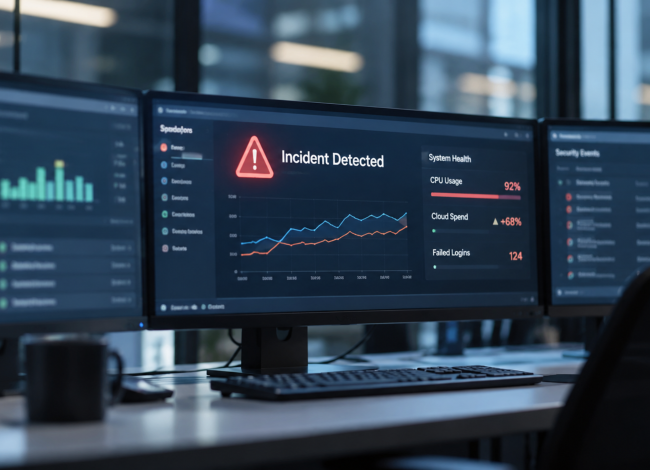
When a cloud anomaly hits at 2 AM, Operations sees a latency spike, Security sees a breach attempt, and Finance sees a five-figure surprise on next month’s bill. Three teams look at the exact same incident, and instantly start fighting three completely different fires. 

Now picture the same night with the gap closed. The latency spike, the unusual login and the change in spend appear on one timeline. Operations, Security and Finance join one call and start from the same facts, not three competing theories. 

The discussion moves straight to what matters. What is the business impact, and what is the safest way to contain it? 

That is the idea behind Sec-Fin-Ops: Security, Finance and Operations working from one shared view of an incident, so risk and cost are weighed together. 

Same incident, three different questions

Each team asks a reasonable question, and each is right from its own position. 

Operations asks 

Security asks 

Finance asks 

Is the application slowing down? 

Is this a malicious activity? 

How much revenue is at risk? 

Why did the infrastructure change? 

Has an account been compromised? 

Is this additional spending justified? 

Why has cloud usage increased? 

Was this an unauthorised change? 

What is the financial impact of recovery? 

The questions aren’t the issue. None of them, on its own, covers the whole incident. Decisions made on part of the picture tend to pull in different directions. 

Why each team sees only part of it

Teams read about an incident through the lens they are measured on. Operations is accountable for uptime and user experience. Security is accountable for detecting and containing threats. Finance is accountable for budget and return. 

Take a common example. A core application starts using double its usual compute. Response times slow, the monthly cloud forecast rises, and an admin account shows unusual activity. 

Operations checks autoscaling rules and recent code changes. Security reviews login logs and monitors outbound traffic. Finance compares daily spending against the quarterly budget. 

All three are chasing a real possibility: a traffic surge from a campaign, a configuration error, or crypto-mining malware. Telemetry from one source can’t tell them which. 

A higher bill doesn’t confirm a breach, and a high CPU doesn’t confirm an attack. Any theory needs to be validated against evidence. 

Muhammad Dennisa shares how compromised credentials led to unauthorised crypto-mining, driving up cloud costs and requiring immediate security and production changes to contain the incident.

“I once dealt with a typical coin-mining case. Credentials had been deliberately pushed to a public GitHub repository. As CTO at the time, the first thing I saw was an alert about an unusual cost spike in Firebase, in which I have to take action immediately by revoking the credentials and had my team deploy new ones to production. The alert usually reaches the EA or DevOps first, then escalates to the CTO.” 

Muhammad Dennisa, Senior Manager of Solutions, Cybots AI 

Where sound decisions pull in different directions

Operations adds capacity to keep customers online. That is the right call for legitimate traffic. If unauthorised compute jobs are driving the load, extra capacity also runs the attacker’s workload. It adds to the bill too. 

Security isolates the suspicious account. That can contain an attack. It can also interrupt a business-critical workflow and lose volatile evidence an investigation need. 

Finance caps resources to control spending, which can slow down a legitimate recovery. 

Each team acts reasonably on what it can see. The outcome depends on whether those actions are taken with all three views in hand. If there is an intrusion, time spent reconciling three theories is time it remains uncontained.

Datadog explains how teams can correlate resource usage, process-level activity and billing anomalies to identify potentially malicious workloads before increasing infrastructure capacity.

Observability platforms such as Datadog can already correlate these signals under the same tags. Correlation isn’t a decision, though. People still have to translate a complex scenario into what it means for the business. 

Closing the gap with one shared view

This doesn’t mean merging three functions into one team. It means putting their three views, and the evidence behind them, in front of the same decision makers at the same time. Here’s what changes: 

Dimension 

Before (siloed first reads) 

After (Sec-Fin-Ops ideal state) 

Incident trigger 

Three separate alerts fire across three different dashboards. 

One unified signal maps the system change, threat context and cost velocity at the same time. 

Triage 

Three after-the-fact alignment calls to debate whose budget or metric is affected. 

One joint decision window weighs technical severity against real-time financial exposure. 

Resolution focus 

“Is the app back up?” / “Is the threat contained?” / “Why did spend jump?” 

“What is the true business impact, and did we resolve it safely within cost targets?” 

closing the gap - photo

Three practices make this work. All three are set up before an incident, so they are ready when one happens.

A Shared Timeline

Record what changed and when, which identities were active, and which facts are validated versus assumed. 

Correlating system metrics, security logs and billing data narrows the possibilities quickly. Where data is missing, record it as a blind spot to investigate. 

Business Impact, Not Just Anomalies

A background process, a slow API and an unexpected cloud charge may be one event or three. Validate the link before acting on it. 

Then identify which business functions are affected, which decisions are time-sensitive, and what evidence needs to be preserved. 

Decision rights agreed in advance.

Record what changed and when, which identities were active, and which facts are validated versus assumed. 

Correlating system metrics, security logs and billing data narrows the possibilities quickly. Where data is missing, record it as a blind spot to investigate. 

A practical check for your leadership team

Many organisations already detect performance drops, investigate security alerts and flag budget overruns. The next step is bringing those three views together quickly enough to act on them together. 

Sec-Fin-Ops shifts incident response from reactive firefighting to evidence-based decision-making, helping leadership understand business impact and make faster, informed decisions.

Sec-Fin-Ops doesn’t replace incident management. It was meant to adopt into a new model, moving from firefighting in a war room to evidence-based decision making. It enables the CXO make an informed decision faster. 

A simple way to check: take a recent incident that was never fully explained and trace how each function handled it. 

Were they working from the same facts? Did they agree on which customer-facing services were affected? Were assumptions documented? Was it clear who owned the trade-off between availability, containment and cost? 

Wherever the answer is unclear, that is the place to start. 

From what broke to what it costs

Knowing what happened to a system and knowing what it means for the business are different questions. Sec-Fin-Ops brings them together so both are answered in the same decision. 

When they are, the next 2 AM call starts with one set of facts and ends with one decision. 

In the next article, we look at why technical severity scores rarely show leadership what an incident costs. We also look at how to connect the two.